How to Better Control Your Emotions
You can achieve better emotional balance by learning to use your unconscious mind

Do your emotions sometimes run away with you, making you do things you later regret?
Or do you try to act as if feelings have no part in what you do at all?
Both of these extremes are very uncomfortable, aren't they? Letting your rage or your fear or your jealousy dictate what you do so often leads to actions whose consequences are far from what you want.
But quashing your feelings can cut you off from who you really are at heart. Who wants to be a robot?
The trouble is that our emotions can be very powerful things. They can feel quite overwhelming. When a powerful emotion is aroused, it can feel as if you've been taken over.
Everything outside of that emotion just disappears. It is the only thing that matters. It's like you can't even think of anything else while this is happening.
The evolutionary background of emotion
There are good evolutionary reasons why this is so. When you feel an 'emotion', your body is experiencing the flow of certain chemicals, triggered by events and situations around you, whose aim is to get you doing something.
You'll notice that the word 'emotion' contains the word 'motion', that is, movement. Emotions are there to induce action.
But too much emotion overwhelms your judgment. If the level of arousal goes beyond a certain point, you literally can't think straight.
The neo-cortex (basically, the part of your brain responsible for rational thinking), is a relatively new development in human evolution. The amygdala (which drives your emotional responses) is much 'older'.
The good news is that you are not doomed to be at the mercy of the primitive responses of the amygdala for ever. You can learn to calm down your emotional responses. To let them be there, and tell you what you need to know about how you feel, but not let them rule you.
How?
Hypnosis is a great way to master emotional control
Control Your Emotions is an audio hypnosis session that will give you the tools you need to become the 'master of your ship'.
As you relax and listen repeatedly to your download, you'll notice that you:
- Discover how to enter deep states of relaxation (which automatically reduce arousal)
- Learn how to access the 'observing self' - so you can really see what you're doing
- Develop new, clearer perspectives on what to take into account before you take any action
- Can still draw on all the energy and drive that your emotions give you
- Begin to feel you can trust your emotions more, and use them wisely in many different ways.
Download Control your emotions and discover a new dimension to life. You can listen on your computer or device or via our free app that you will be able to access when you have completed your purchase.
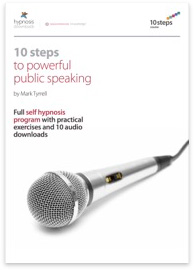
Control Your Emotions is part of our 10 Steps to Powerful Public Speaking Hypnosis Course
Follow Mark Tyrrell's journey from a presentation panic attack to confidently speaking to an audience of 500
Or you can purchase Control Your Emotions below:
Listen to the introduction of Control Your Emotions
Why you can relax about buying from Uncommon Knowledge...

We have helped over a million people with hypnosis since 1998. Uncommon Hypnosis is a creative, permissive, deeply relaxing approach to improving psychological wellbeing and performance that anyone can benefit from.
Mark Tyrrell & Roger Elliott
Co-founders of Uncommon Knowledge »

Control Your Emotions has been purchased by 2,220 customers.
Control Your Emotions
Narrator: Roger Elliott
Length: 23:21
 Listen on all devices or our free app
Buy these together Control Your EmotionsKeep a Cool Head and save $6.95
(These products are specially selected to maximize your results from your hypnosis.)
Most popular sessions in Emotional Intelligence




Why we're different to other hypnosis providers:

We're experienced and dedicated therapist trainers
Uncommon Knowledge was formed in 1998, and since then we've trained over 24,000 people at face-to-face events. We've served millions of self hypnosis audio sessions and treated more than 5,000 patients in 1:1 therapy. Our uncommon approach to hypnosis is unique in the field.

More than a million customers
With more than 1 million customers since 2003, we are proud to serve people from all over the globe. With instant access to all of our products, there's no limit to how we can help you.

9566 people are happy with our customer service

Our small support team is dedicated to making your experience with Uncommon Knowledge a lovely, and hopefully long one.